Continuous Waves, Quasi-Continuous Waves, and Pulsed Waves: A Complete Analysis from Laser Physics to Clinical Applications
Laser Emission Mode Analysis: A Complete Guide from Physical Properties to Clinical Applications of CW, QCW, and PW
Laser Emission Modes Guide
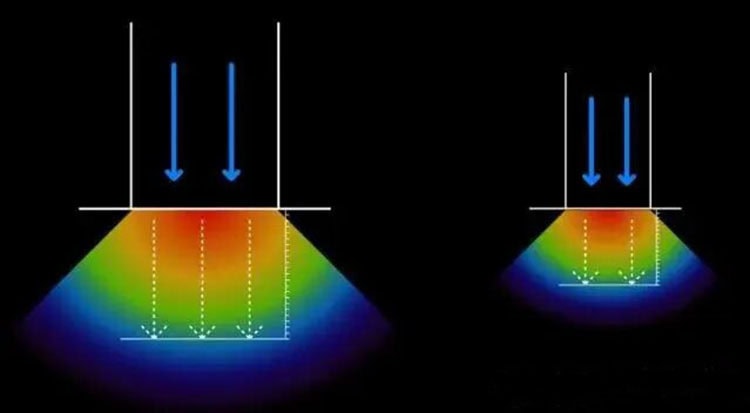
Why do some devices emphasize continuous wave (CW), others pulsed wave (PW), and still others quasi-continuous wave (QCW) when using the same 1064nm laser?
In the field of laser medicine, wavelength determines which components absorb the light energy, while the emission mode determines how tissue responds.
Understanding the differences between CW, QCW, and PW not only helps in correctly interpreting device parameters but is also fundamental to understanding laser-tissue interaction.
Why is launch mode more important than we think?
In many laser device promotional materials, wavelength parameters such as 810nm, 980nm, 1064nm, and 1940nm are often prominently displayed.
However, from a histological perspective, wavelength is not the only factor determining treatment effectiveness.
At the same wavelength, different emission modes can lead to entirely different outcomes:
- Thermal accumulation process;
- Penetration characteristics;
- Tissue damage patterns;
- Safety boundaries;
- Clinical outcomes.
Therefore, in recent years, more and more research has begun to focus on: how laser energy is delivered to tissues.
(Chaki et al., 2025;Schoppink et al., 2022)
ⅠContinuous wave (CW) is the most classic laser output method
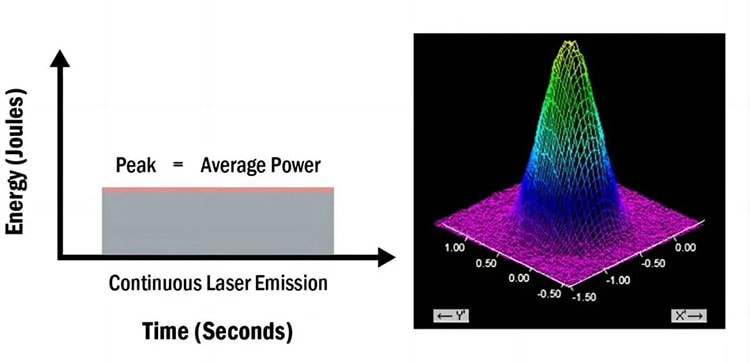
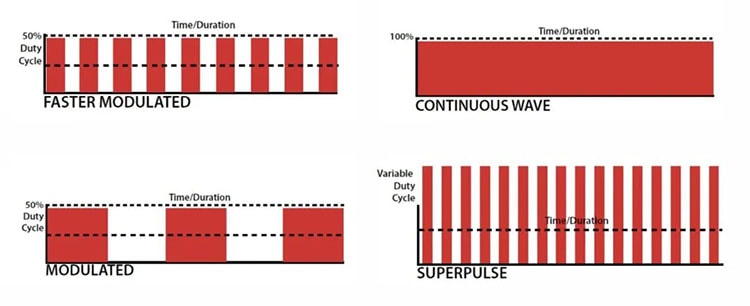
Once the device is started, the laser continuously outputs energy with virtually no interruption for a set time.
From an engineering perspective:
Duty Cycle ≈ 100%
The tissue continuously receives energy.
Therefore, the tissue temperature gradually increases and a steady thermal effect is formed.
Histological features of CW
The most typical characteristics of continuous wave photocoagulation include:
✔ Sustained thermal deposition
✔ Stable coagulation
✔ Good hemostasis
✔ Highly efficient vaporization
Therefore, it is widely used in:
Prostate vaporization
Soft tissue resection
Continuous wave cyclophotocoagulation (CW-CPC)
Tm:YAG continuous vaporization therapy
(Huusmann et al., 2021;Souissi et al., 2020)
Limitations of CW
The continuous energy input of CW means that heat accumulates continuously.
When tissue heat dissipation capacity is insufficient, the following can easily occur:
- Increased heat diffusion
- Expansion of deeper damage
- Carbonization
- Enhanced postoperative inflammatory response
Therefore, while CW mode is efficient, its thermal safety window is relatively narrow.
Ⅱ What is a pulse wave (PW)?
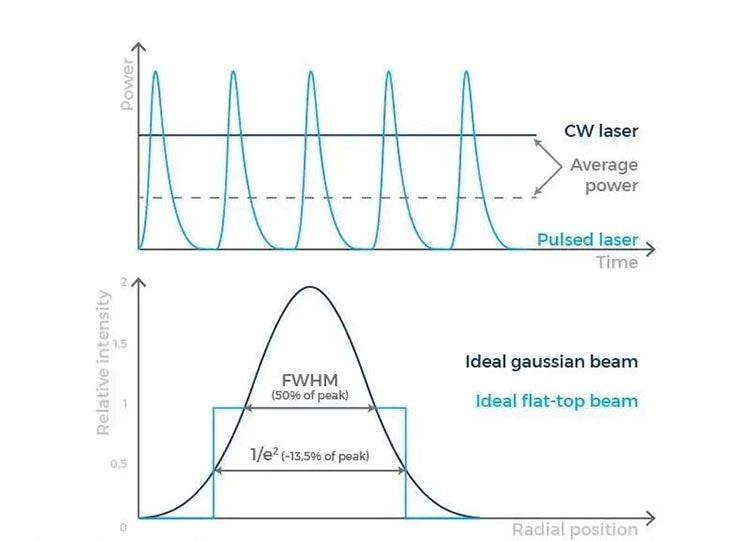
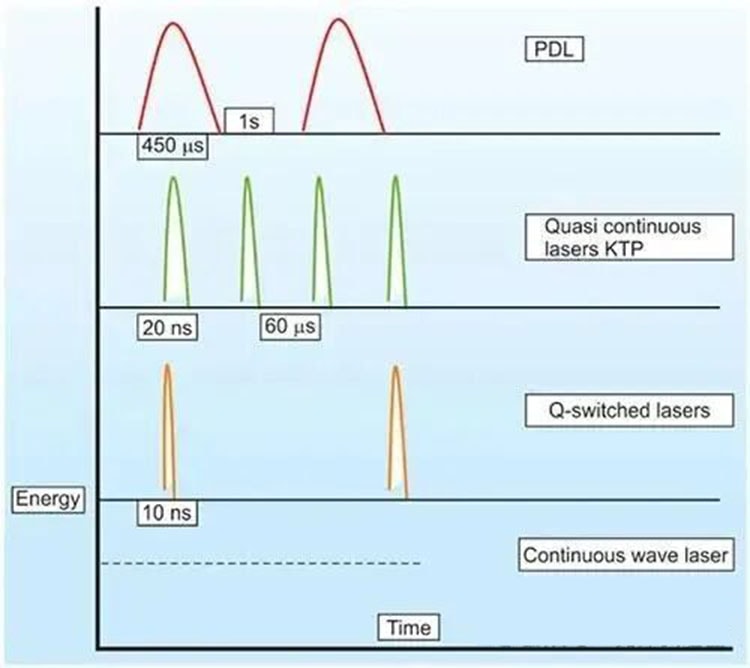
Unlike continuous waves, pulsed waves (PWs) do not emit light continuously.
They output energy in the form of:
█ █ █ █ █
with an off-time between each pulse.
Therefore, tissues can dissipate heat between two pulses.
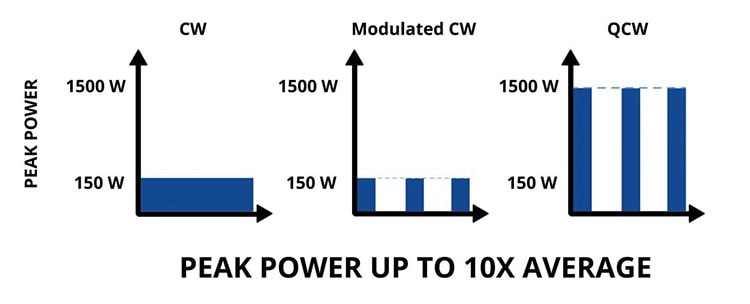
The biggest feature of PW: peak power
While the average power may be similar to CW, PW typically has higher values:
Peak Power
For example: Average power 10 W
Continuous Wave: 10 W continuous output;
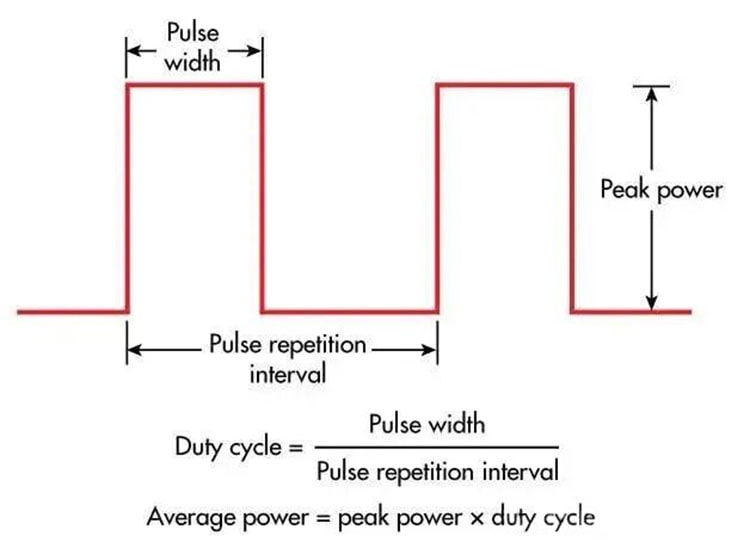
Pulse Wave may exhibit: 100 W peak × 10% duty cycle, with an average of 10 W.
Why is peak power important?
Why is peak power important? Because tissue response involves more than just heating.
High peak power can also induce:
- Vapor Bubble;
- Cavitation;
- Shock Wave;
- Photomechanical Effect;
(Schoppink et al., 2022)
III What is Quasi-Continuous Wave (QCW)?
Many devices advertise “continuous output,” but QCW is essentially still a pulse mode.
It simply has a longer pulse width, higher frequency, and larger duty cycle, making it appear almost continuous to the naked eye.
QCW’s core advantages
- QCW retains:
- Continuous Baud Rate
- Higher Average Power
- Pulse Baud Rate
- A Cooling Window Exists
Therefore, at higher output power, some heat buildup issues can be reduced.
(Liu et al., 2025;Zhou et al., 2025)
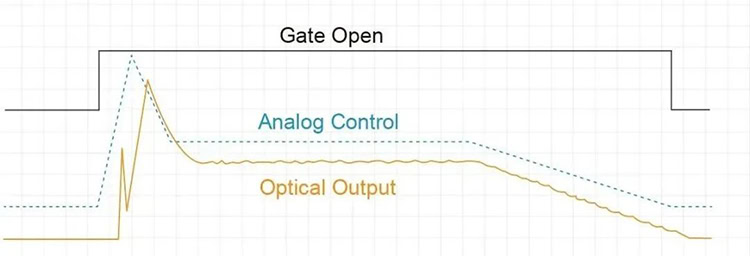
IV Why do CW and PW have different effects at the same wavelength?
Why do CW and PW wavelengths produce different results at the same wavelength?
This is a very common question in clinical practice. Taking 1064 nm as an example: the tissue absorption characteristics do not change due to the change in mode.
What changes is:
The time structure of energy reaching the tissue.
(1) New evidence from the HILT field
Chaki et al. (2025) used Monte Carlo and finite element models to compare the propagation behavior of 1064 nm laser in tissue under CW and PW modes.
The study found that, under simulated conditions, the PW mode exhibited:
- lower surface temperature rise;
- higher depth flux.
Tip: Pulsed mode may be beneficial for deep light transmission.
(Chaki et al., 2025)
ⅤApplication of Different Modes in Clinical Practice
| Emission Mode | Main Advantages | Typical Applications |
| CW | Stable coagulation, vaporization & hemostasis | CW-CPC, soft tissue incision, prostate vaporization |
| PW | Controlled thermal damage, high peak power, mechanical ablation effect | Ho:YAG lithotripsy, EVLA, PBM therapy |
| QCW | Balanced working efficiency & thermal management | Micro-pulse glaucoma treatment, high-power diode laser |
Ⅵ Conclusion
The difference between continuous wave, quasi-continuous wave and pulse wave is not just whether the laser output is continuous.
They essentially represent three different energy transfer strategies:
- Continuous waves emphasize sustained thermal effects;
- Pulsed waves emphasize peak power and thermal management;
- Quasi-continuous waves attempt to strike a balance between efficiency and safety.
For clinicians, what truly matters is not the “CW” or “PW” labels in device marketing materials, but rather:
Pulse Width, Frequency, Duty Cycle, Peak Power, and Average Power.
These parameters collectively determine the form of energy ultimately perceived by the tissue, and thus define the boundaries between therapeutic efficacy and safety.

Leave a comment