
Inside the Cap: Why Mixing LED and VCSEL Tech is the Secret to Growth
Ⅰ655nm red light: LED efficiency can be very high, while VCSEL is still catching up.
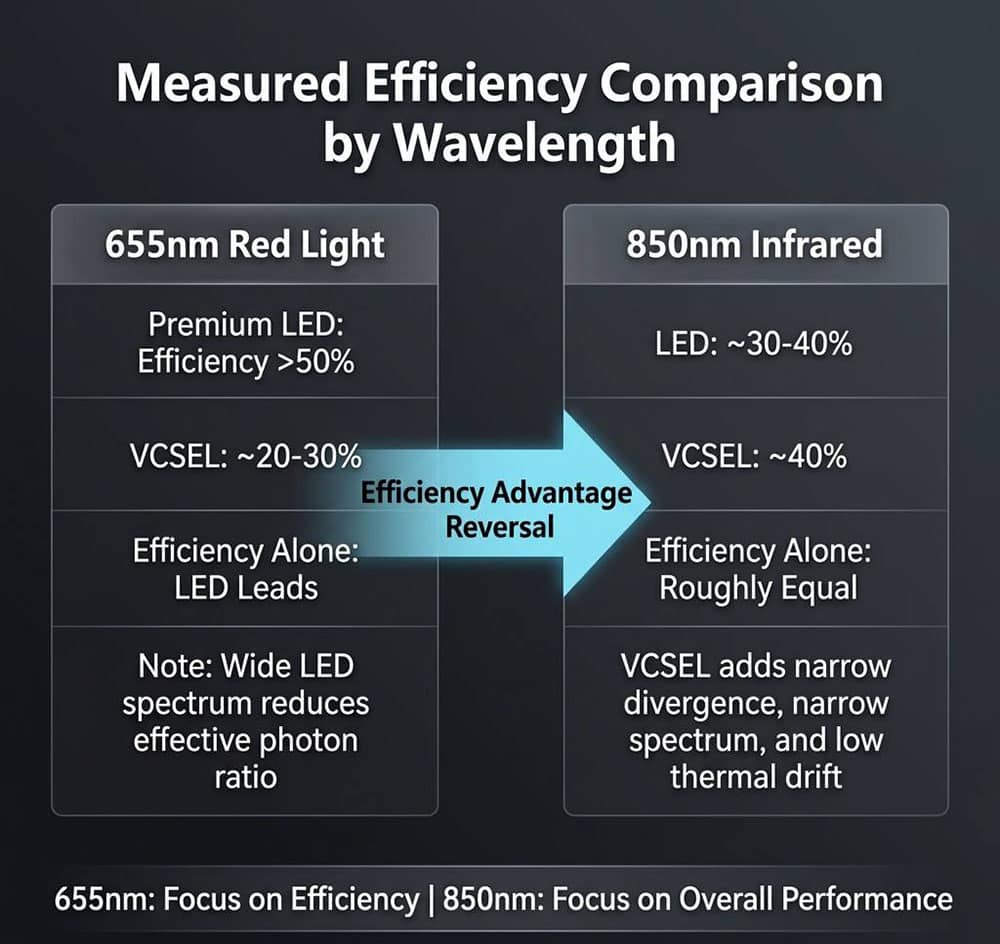
For 655nm red LED, top-tier manufacturers can achieve a photoelectric conversion efficiency of over 50%. This is not a theoretical limit, but actual measured data: for every 100 units of electrical energy input, more than 50 units are converted into useful 655nm red light, while less than 50 units turn into heat.
For 655nm red VCSEL, the efficiency of a single chip currently ranges from 20% to 30%. For every 100 units of electrical energy input, 20 to 30 units become light, while 70 to 80 units turn into heat.
s of efficiency alone, the LED wins. The difference isn’t just a few percentage points; it is a gap of more than double.
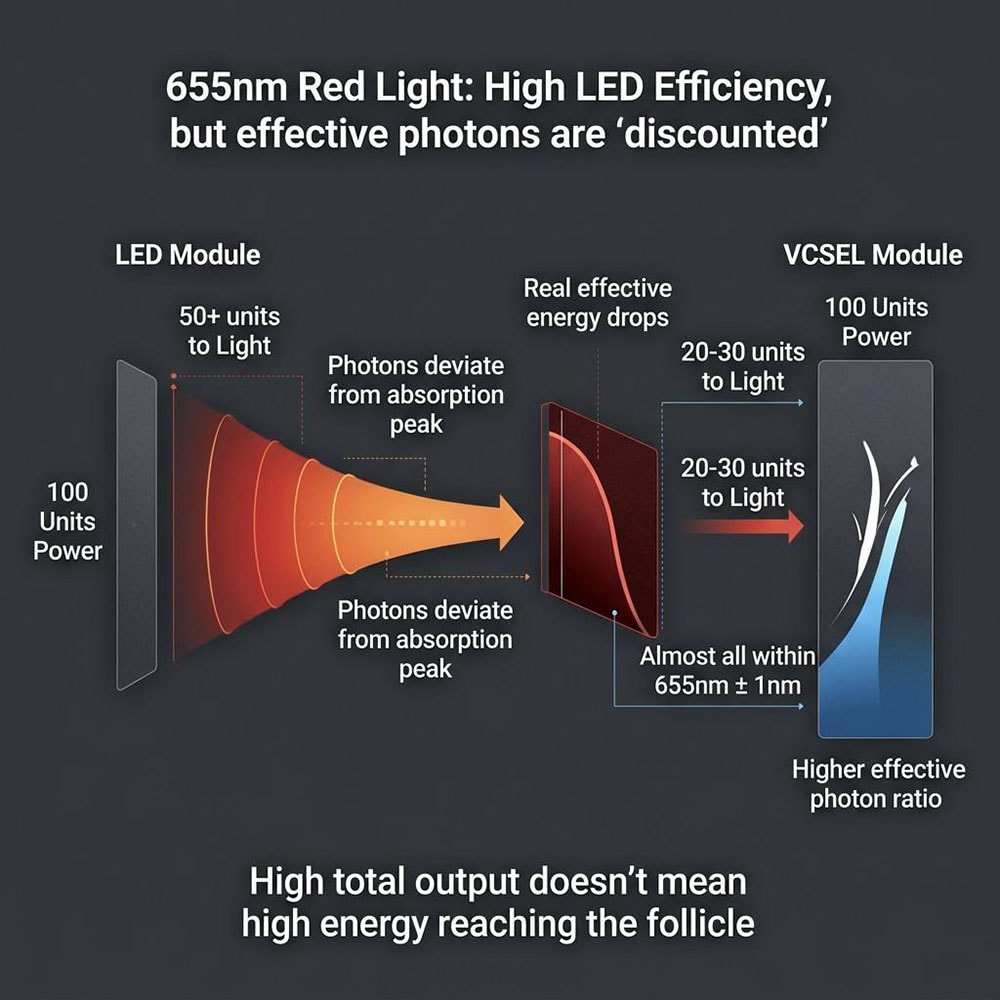
However, that is only the story at the light source level. As discussed in the previous post regarding spectral bandwidth, the actual output wavelength of an LED spans 620nm to 680nm; many photons fall outside the hair follicle’s absorption peak, so even if 50 units of light are emitted, the amount actually absorbed by the follicles is significantly lower. In contrast, VCSEL output is concentrated within ±1nm of 655nm, meaning almost all emitted photons fall within the target wavelength range. Think of it this way: one has a large bucket but spills a lot along the way, while the other has a smaller bucket but loses almost nothing. Efficiency is the starting point, not the final verdict.
ⅡFor 850nm infrared, LED efficiency struggles to improve, whereas VCSEL performance is on par or even superior.
The photoelectric conversion efficiency of 850nm infrared LED typically ranges from 30% to 40%. This is notably lower than that of 655nm red LED, primarily due to higher rates of non-radiative recombination in infrared materials.
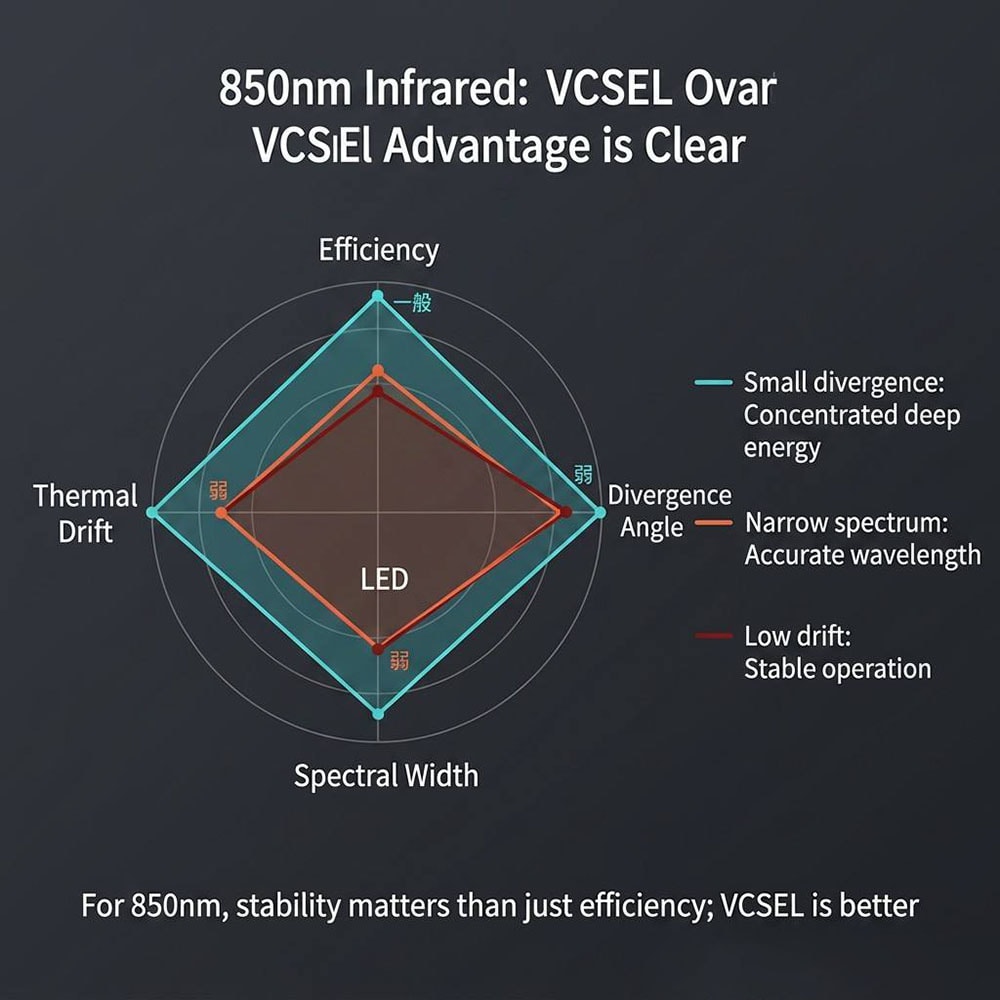
In contrast, the efficiency of 850nm infrared VCSEL currently stands at around 40%; they match LED at the very least, and high-performance models can even surpass them.
Consequently, at the 850nm wavelength, the efficiency advantage previously held by LED disappears. When combined with the physical advantages of VCSEL—namely narrow divergence angles, narrow spectral widths, and low thermal drift—VCSEL prove to be superior to LED overall.
ⅢFor the same housing, the logic for selecting light sources across the two wavebands is reversed.
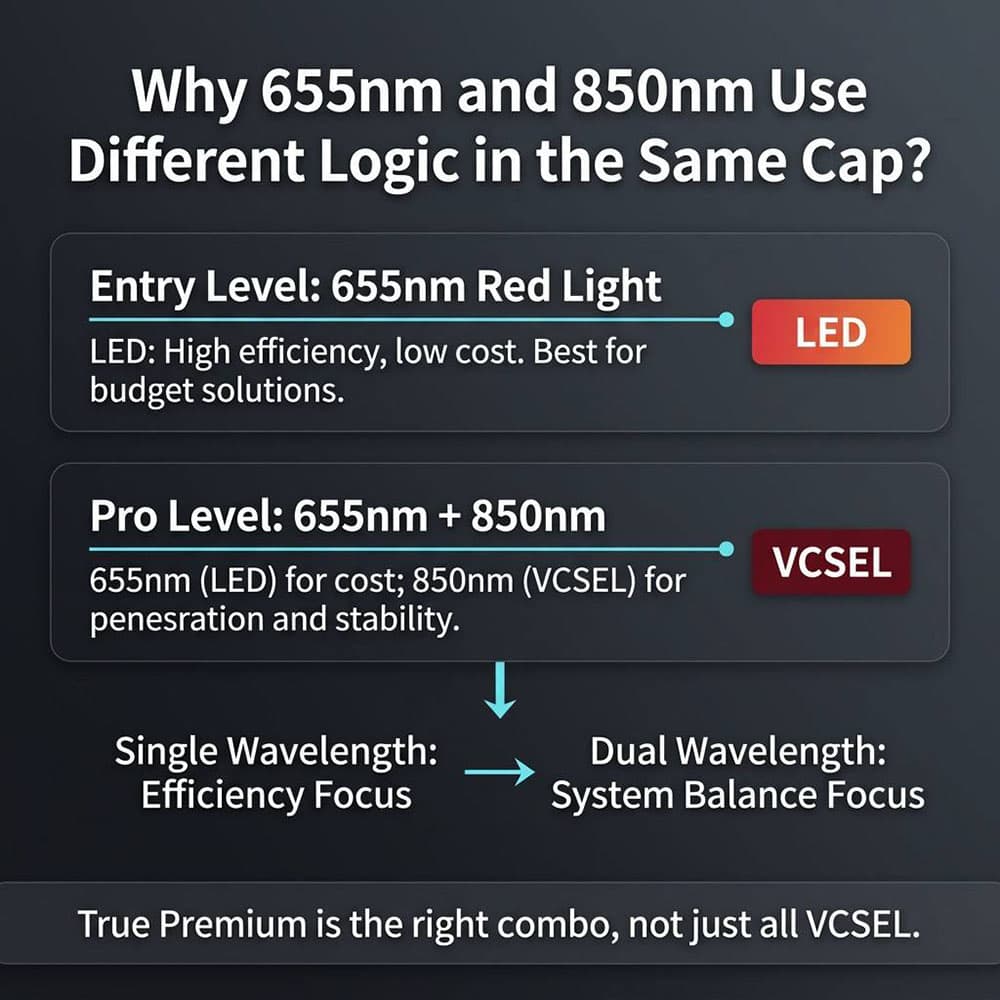
Entry-level hair growth caps utilize only 655nm red light. In this wavelength range, LEDs significantly outperform VCSELs in terms of efficiency and offer lower costs; if high-efficiency LEDs are available, they certainly hold the advantage here. Although VCSELs lag in raw efficiency, their physical advantages—specifically beam divergence, spectral characteristics, and thermal stability—compensate substantially, meaning the proportion of photons effectively reaching the hair follicles is not necessarily lower. Each approach involves trade-offs, so all four parameters must be considered together.
“Pro” model hair growth caps employ a dual-wavelength setup, combining 655nm and 850nm. Here, the logic for selecting light sources shifts. LED are used for the 655nm wavelength due to their high efficiency and low cost. VCSEL are used for the 850nm wavelength; their efficiency rivals that of LED, and when combined with those three physical advantages, they offer superior overall performance. Furthermore, 850nm VCSEL generate less waste heat than LED, ensuring the cap does not become uncomfortably hot despite the addition of a second wavelength.
Using two different light source technologies for two wavelengths within the same product is not an unnecessary complication; rather, it is a rational choice based on the specific characteristics of each wavelength.


Leave a comment