
Why does sensitive skin become increasingly sensitive?
Many people with sensitive skin initially experience only occasional redness during seasonal changes, stinging after staying up late, and slower recovery after using acid peels. However, gradually, the skin seems to become increasingly “fragile.”
Washing the face with warm water causes a burning sensation, using regular face cream causes a stinging sensation, the skin reddens easily in the wind, and wearing a mask for a short time causes redness and itching.
Many people then wonder: Is my skin getting thinner? Actually, increasingly sensitive skin isn’t just a surface problem.
It often involves two systems: a weakened skin defense system and an increased alertness of the sensory nervous system.
From a neurophysiological perspective, the “increasing sensitivity” of sensitive skin can be understood as a decrease in the reaction threshold of the skin’s sensory system.
It shares a similar underlying logic with hyperalgesia and abnormal pain in pain medicine: what is originally a mild stimulus is amplified, and what is originally harmless may be perceived as discomfort.
In other words, sensitive skin isn’t simply “thin skin,” but rather the skin entering a state of high alert.
1. Sensitive skin isn’t simply thinner skin; it’s that the skin’s alarm threshold has been lowered.
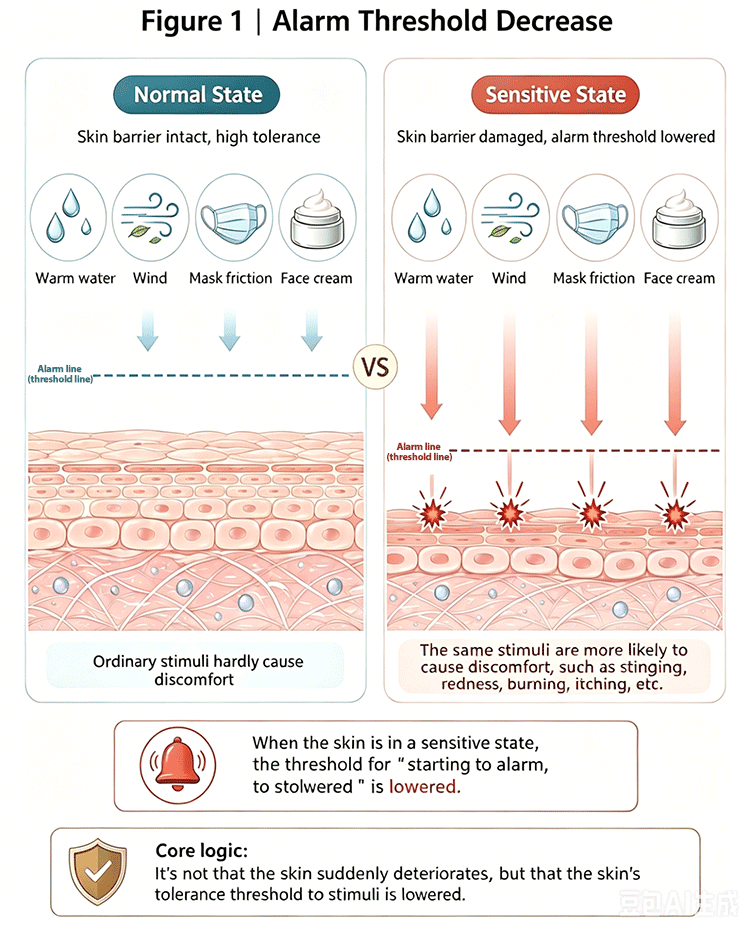
Simply put, the threshold is the critical point at which the skin begins to “sound alarm.” Under normal circumstances, the skin doesn’t react noticeably to minor daily stimuli. However, when skin sensitivity increases, it overreacts to the same mild stimuli, easily experiencing discomfort such as stinging, burning, itching, or redness.
For example:
- I used to feel nothing when washing my face with warm water, but now my skin feels red and hot after washing.
- The face cream I used to use now stings as soon as I apply it.
- I used to only feel stuffy when wearing a mask, but now my face turns red after wearing it for a while.
- I used to have no problem with being exposed to wind, but now my skin feels tight and itchy when exposed to wind.
This is your skin’s distress signal: its alarm system has become overly sensitive. When skin is chronically irritated, inflamed, dry, or has a damaged barrier, sensory nerves are more easily activated. Nerve responses that previously required strong stimulation can now be triggered by even mild irritation. The primary reason sensitive skin becomes increasingly sensitive is not that it has suddenly worsened, but rather that its tolerance threshold for irritation has decreased.
2.Barrier damaged: Stimuli can enter more easily
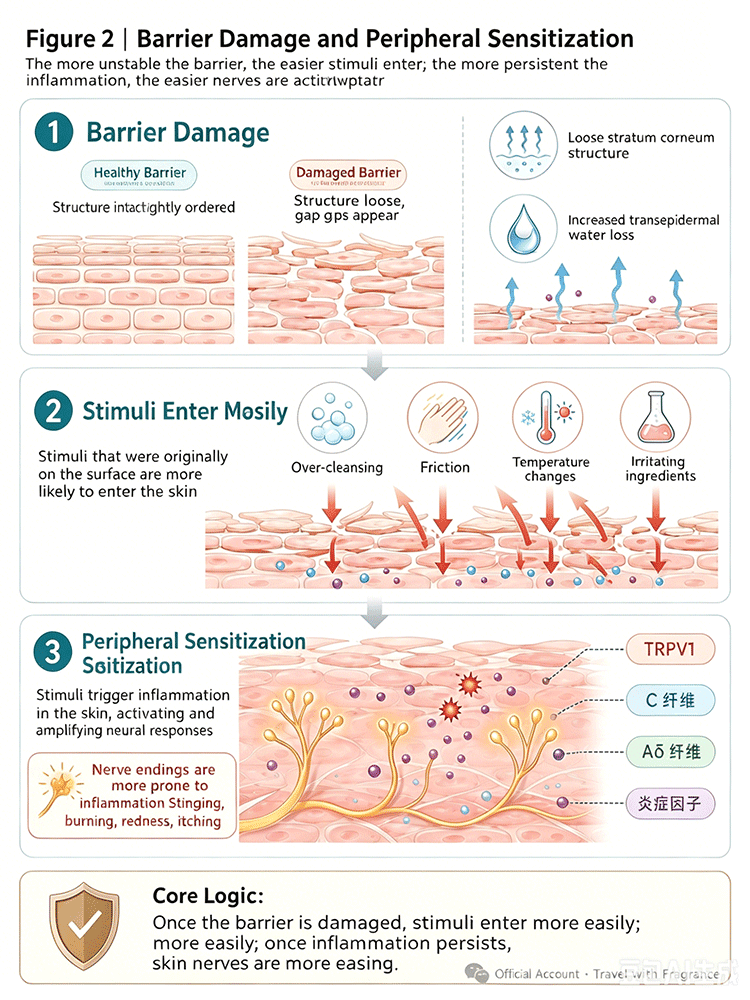
Most sensitive skin problems stem from a compromised skin barrier function. The outermost layer of the skin, the stratum corneum, acts like a protective wall. A healthy stratum corneum helps the skin retain moisture and prevents external irritants from entering, such as cleansers, fragrances, preservatives, pollutants, as well as changes in temperature and friction.
When the stratum corneum is damaged, two problems will occur.
1.Skin cannot retain moisture
The essence of insufficient water retention is increased transepidermal water loss, also known as elevated TEWL (transepidermal water loss rate). When the skin cannot effectively retain moisture, it becomes dry, tight, rough, and may even peel.
2. External stimuli can more easily penetrate the skin.
When the skin barrier is compromised, irritants that would otherwise remain on the skin’s surface can more easily penetrate the stratum corneum and reach deeper living cells and nerve endings. At this point, the skin will recognize many ordinary irritants as “threats.”
For example, you may not feel any irritation when using a face cream normally, but if your skin barrier is damaged, you may experience symptoms such as stinging, burning, or redness when using the same face cream again.
At this point, you shouldn’t just focus on whether the ingredients in this face cream are irritating; the key is whether your current skin condition can tolerate these irritants.
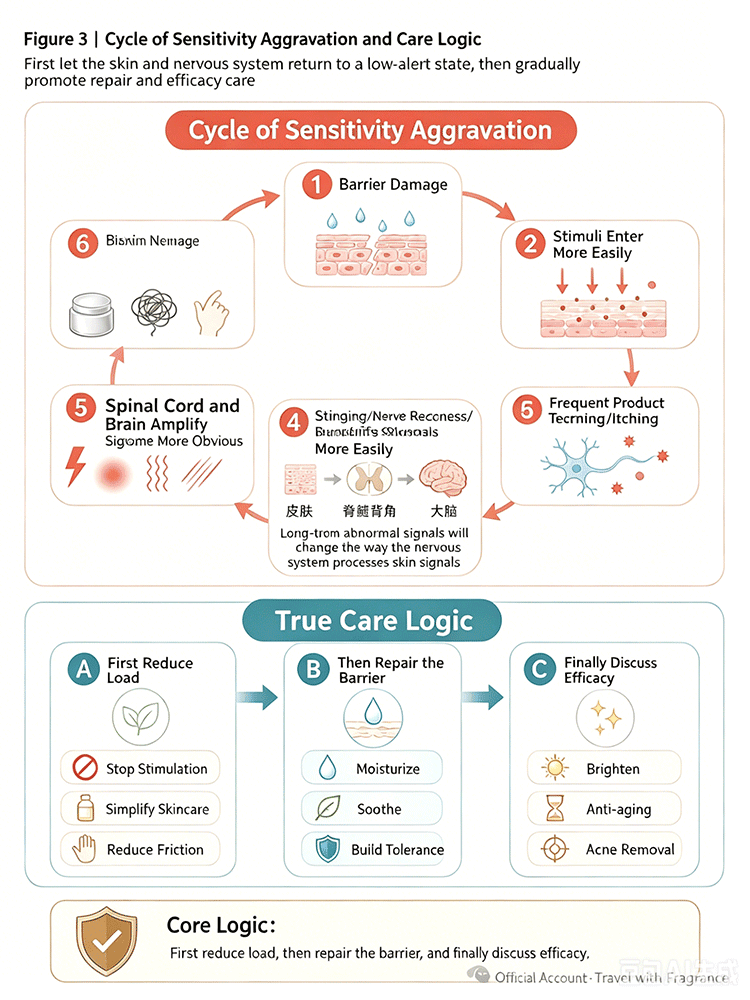
When the skin barrier is damaged, irritation is more likely to occur; the more irritation occurs, the more likely inflammation is to persist; the more persistent the inflammation, the more easily the skin nerves are activated, thus making sensitive skin even more sensitive in this cycle.
3.Peripheral sensitization: Skin nerves become more easily activated
The skin is not a static protective membrane; it contains a large number of sensory nerves. These nerves can sense temperature, pain, itching, chemical irritation, and mechanical stimulation. C fibers and Aδ fibers play a crucial role in the perception of tingling, burning, pain, and temperature.
On these nerve endings, there are ion channels responsible for sensing stimuli (such as TRPV1). These channels can be activated by heat, acidic environments, inflammatory factors, and certain irritants. TRPV1 is also known as the capsaicin receptor; when you feel a burning sensation after eating chili peppers, it is actually capsaicin activating TRPV1 receptors in your body.
When the skin barrier is damaged and inflammation persists, various inflammatory factors (including prostaglandins, cytokines, and neuropeptides) are released locally. These substances increase the excitability of sensory nerves, ultimately leading to a significant decrease in the excitation threshold of nerve endings.
Previously, a stronger stimulus was needed to feel a stinging sensation; now, even slight warmth, friction, or contact with active ingredients can produce noticeable discomfort. This phenomenon is called ‘peripheral sensitization’.
‘Peripheral’ refers to the nerve endings on the skin’s surface, and ‘sensitization’ means that these nerves are in a state where they are particularly easily excited, reacting to even slight stimuli and readily transmitting stimulus signals.
Sensitive skin becomes more sensitive not only because the stratum corneum thins or becomes dehydrated, but more importantly, because the sensory nerves in the skin are in a state of heightened ‘excitation’.
This also explains why some people experience facial stinging, itching, and burning discomfort even without obvious skin damage. The problem lies not only in the skin’s surface but also in the reaction patterns of the sensory nerves.
4. Central nervous system involvement: The brain amplifies long-term discomfort signals
If the skin continuously sends signals of stinging, burning, itching, and discomfort to the nervous system over a prolonged period, these signals not only remain locally on the skin but also continue to travel upwards, first reaching the dorsal horn of the spinal cord and then further to the brain.
The dorsal horn of the spinal cord is a crucial “transfer station” for sensory signals from the skin after they enter the central nervous system. Under normal circumstances, this area filters and modulates the signals, filtering out some milder ones.
However, under prolonged abnormal stimulation, the neural networks in the dorsal horn of the spinal cord may undergo changes in neuroplasticity, entering a state of hyperexcitability. The “gate” function, originally responsible for filtering and regulating signals, becomes unstable, and ordinary signals are more easily amplified and transmitted.
These are some signs of worsening symptoms in sensitive skin:
- pain upon light touch;
- stinging sensation when wiping the face with tissue paper;
- redness after rubbing against the edge of a mask;
- discomfort even without applying any skincare products.
All of the above phenomena are related to the brain’s regulatory mechanisms.
Skin discomfort is not merely a simple sensory issue; it also involves emotions, attention, and expectations. If a person suffers from chronic sensitivity, they are prone to overreacting to skincare, seasonal changes, wind, and sun exposure.
This overreaction is not simply a psychological effect, but rather the brain’s prediction and evaluation of bodily signals based on past experiences.
If you’ve experienced stinging after using skincare products multiple times, even if you subsequently use milder products, your brain may still prematurely activate its alert system. At this point, your attention will focus on your face, trying to capture the subtle sensations; the stronger your anxiety about the stimulus, the more easily the discomfort will be amplified.
This is essentially the nocebo effect—simply put, the more negative your expectations, the more likely your body will feel uncomfortable.
5. The true logic of nursing care: First simplify, then discuss repair and efficacy.
Having understood the aforementioned neural mechanisms, it becomes clear that the most important aspect of sensitive skin care is not ‘immediate repair,’ nor ‘immediate whitening, anti-aging, or acne treatment.’
The real first step is: subtraction.
Because when both the skin and nervous system are in a state of high alert, any over-care can become a new irritant.
As sensitive skin becomes increasingly sensitive, the care logic should be divided into three stages.
- First, reduce irritation and let the skin calm down. The key to this step is to subtract.
Stop using acid-based products, exfoliating scrubs, high-concentration whitening products, and strong anti-aging products.
Reduce the frequency of changing skincare products.
Avoid over-cleansing.
Don’t use excessively hot water to wash your face.
Reduce friction, such as repeatedly rubbing your face, frequently applying face masks, or layering thick skincare products.
- Stop using acid-based products, exfoliating scrubs, high-concentration whitening products, and strong anti-aging products.
- Reduce the frequency of changing skincare products.
- Avoid over-cleansing.
- Don’t use excessively hot water to wash your face.
- Reduce friction, such as repeatedly rubbing your face, frequently applying face masks, or layering thick skincare products.
Have you ever considered that your sensitive skin’s recurring problems might not be due to a lack of repairing ingredients, but rather because your skin is subjected to too much stimulation and burden every day?
- Repair the skin barrier first, then rebuild the skin’s defense system.
After the irritation subsides and symptoms such as stinging, burning, and redness are significantly relieved, proceed to the barrier repair phase.
At this point, select ingredients that help stabilize the skin barrier, such as ceramides, cholesterol, fatty acids, panthenol, hyaluronic acid, squalane, and soothing ingredients like centella asiatica.
However, it’s important to note that for sensitive skin repair, more ingredients are not necessarily better; rather, a more stable, simpler, and more tolerable formula is preferable.
For highly sensitive skin, a gentle, stable, and long-lasting basic moisturizing product is often more important than a complex, functional product.
- Finally, let’s discuss its whitening and anti-aging effects.
Many people experience recurring worsening of sensitive skin because they follow the wrong skincare routine. They rush to use acids while their skin is still stinging, red, and dry; they use high-concentration whitening products before their skin barrier is stable; and they start layering anti-aging serums as soon as their skin begins to improve.
This creates a cycle of ‘just as it’s starting to repair, it’s irritated again.’ For sensitive skin, all functional skincare products should only be added gradually after the skin’s condition has stabilized.
First, allow the skin to recover to a stable state, then gradually introduce active ingredients. Try only one new product at a time, starting with a low frequency, observe your skin’s tolerance, and then gradually adjust. Sensitive skin should not be forcibly treated with functional skincare products when it is in a highly sensitive state.
6.Ending
Sensitive skin becomes increasingly sensitive, not only because the skin is thinning, but more like a series of chain reactions from the skin barrier to the nervous system.
- When the nerve barrier is damaged, external stimuli can more easily penetrate.
- Local inflammation makes sensory nerves more easily activated.
- Long-term abnormal signals can amplify ordinary stimuli in the spinal cord and brain.
Ultimately, even slight touch, temperature changes, or routine skincare steps can trigger noticeable stinging, burning, itching, or redness.
The key to sensitive skin care is to help the skin’s defense system and sensory nervous system gradually return to a calm state from a state of high alert.



Leave a comment