What wavelength should you choose for a hair growth cap? 650nm red light is the baseline—should you also add 850nm infrared light?
Many clients developing hair growth caps ask the same question during the product definition stage:
“Most hair growth caps on the market use 650nm red light, but some products have started incorporating 850nm infrared light. Is infrared actually effective? Should I include it?”
Let’s break this question down today.
Ⅰ. Why is 650nm red light the standard feature for hair growth caps?
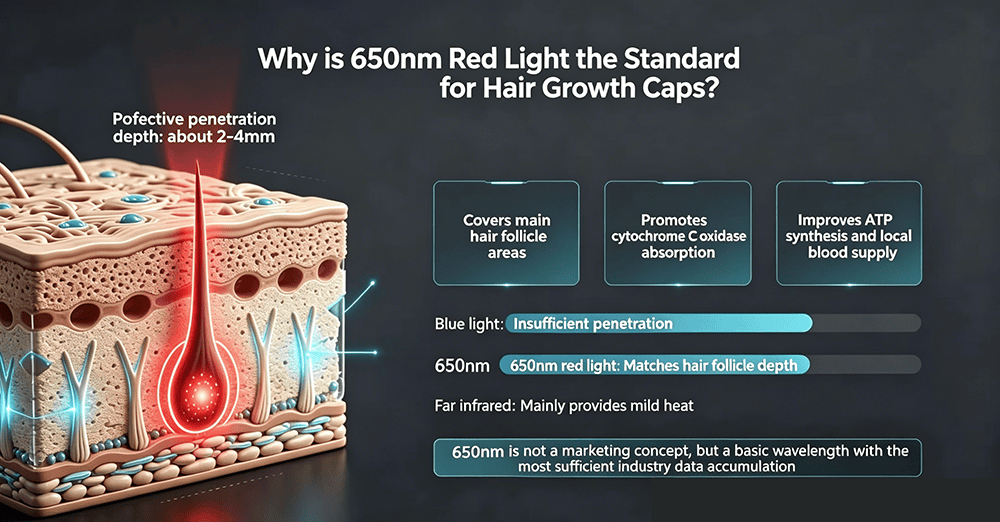
Research into low-level laser therapy for hair growth dates back to the 1960s. Decades of clinical validation have established red light at a wavelength of approximately 650 nm as the band with the most robust body of data in this field.
This is due to the match between the light’s penetration depth and the location of the hair follicles. Hair follicle roots lie 2 to 4 mm beneath the skin’s surface, spanning the transition zone between the deep dermis and the subcutaneous tissue. Red light at 650 nm has an effective penetration depth of roughly 2 to 4 mm in skin tissue, precisely covering the area where hair follicles are situated. Blue light, with its shorter wavelength, cannot penetrate to this depth; conversely, while infrared light—with a longer wavelength—penetrates deeper, the absorption peaks for melanin and hemoglobin do not align with that range, resulting in different photobiomodulation efficiency.
Regarding the mechanism of action, findings in published literature are clear: red light is absorbed by cytochrome c oxidase within the mitochondria of hair follicle cells, thereby enhancing the efficiency of the electron transport chain, boosting ATP synthesis, and improving local energy metabolism. Simultaneously, red light upregulates nitric oxide levels, dilates microvessels, and improves blood supply to the area surrounding the hair follicles. Collectively, these effects prolong the hair follicle’s growth phase (anagen) and shorten the resting phase (telogen).
For the mainstream home-use hair growth caps currently on the market—ranging from entry-level models costing a few hundred yuan to high-end versions priced at two or three thousand yuan—650 nm red light serves as the core wavelength. This is not merely a choice made by a single manufacturer, but an industry-wide consensus.
Ⅱ. What are the benefits of adding 850nm infrared?
Since 650nm is sufficient, why add 850nm?
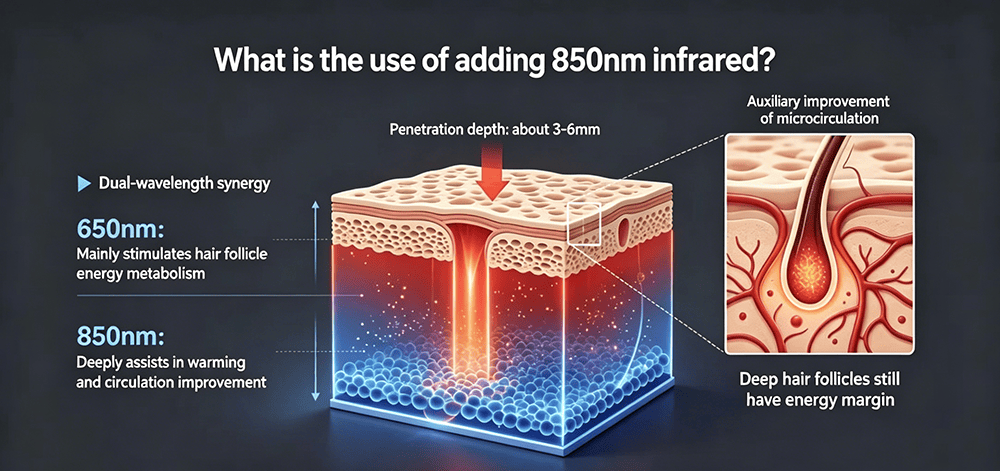
The difference lies in penetration depth. 850nm infrared light penetrates skin tissue to a depth of approximately 3 to 6mm—deeper than 650nm light. As some hair follicle roots are located at depths of 3 to 4mm, the energy of 650nm light diminishes significantly by the time it reaches that level, whereas 850nm light retains more effective energy. Additionally, infrared light is more effective than red light at dilating capillaries, thereby aiding blood circulation around the hair follicles.
This is why some “Pro” model hair growth caps on the market have adopted a dual-wavelength approach combining 650nm and 850nm. The rationale presented is that 650nm light primarily stimulates the hair follicles, while 850nm light provides supplementary deep-tissue warming and improves circulation; the two wavelengths work synergistically for better results.
This logic is physically sound. However, there is one crucial prerequisite: the type of light source used for the 850nm wavelength.
Ⅲ. Do LED infrared and VCSEL infrared yield the same results?
They are different; the key lies in the divergence angle.
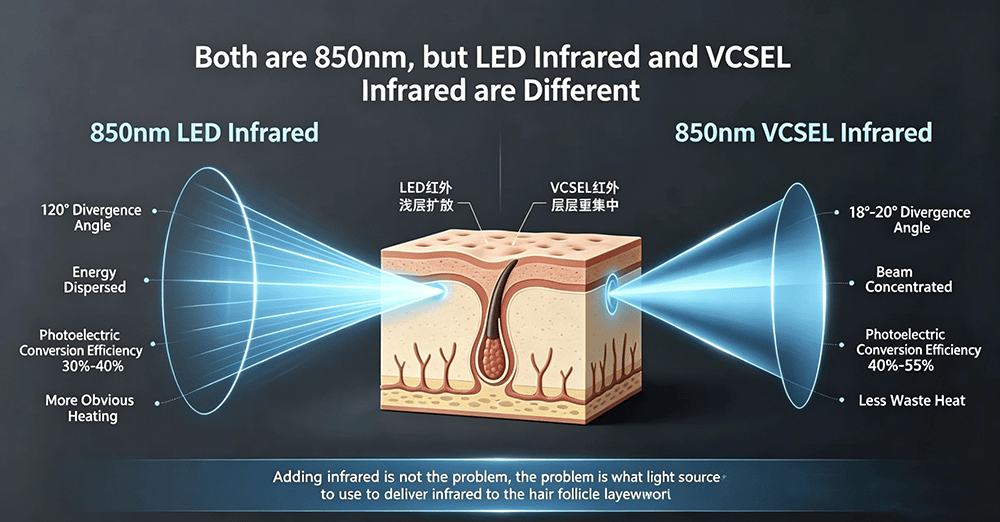
An 850nm LED also has a divergence angle of 120°. Light emitted from the chip spreads in all directions, so by the time it penetrates to deep hair follicles—at depths of 3mm or more—the effective energy has already significantly diminished.
A bigger issue is heat generation. As discussed regarding photoelectric conversion efficiency, infrared LED chips typically convert only 30% to 40% of electrical energy into light, with more than half turning into heat. Since a hair-growth cap is an enclosed space, adding infrared LEDs raises the internal temperature, making the cap uncomfortable for users to wear, especially in summer.
In contrast, an 850nm VCSEL has a divergence angle of 18° to 20°; the beam is concentrated, allowing for a penetration depth of over 4mm. Furthermore, its photoelectric conversion efficiency typically ranges from 40% to 55%, generating less waste heat than an LED, so adding the infrared wavelength does not significantly raise the temperature inside the cap.
The conclusion is that while adding infrared light is beneficial in itself, the choice of light source makes a vast difference in terms of effectiveness and user experience.
Leave a comment