Nature Feature: The Science Behind Red Light Therapy—How Exactly Does It Work?
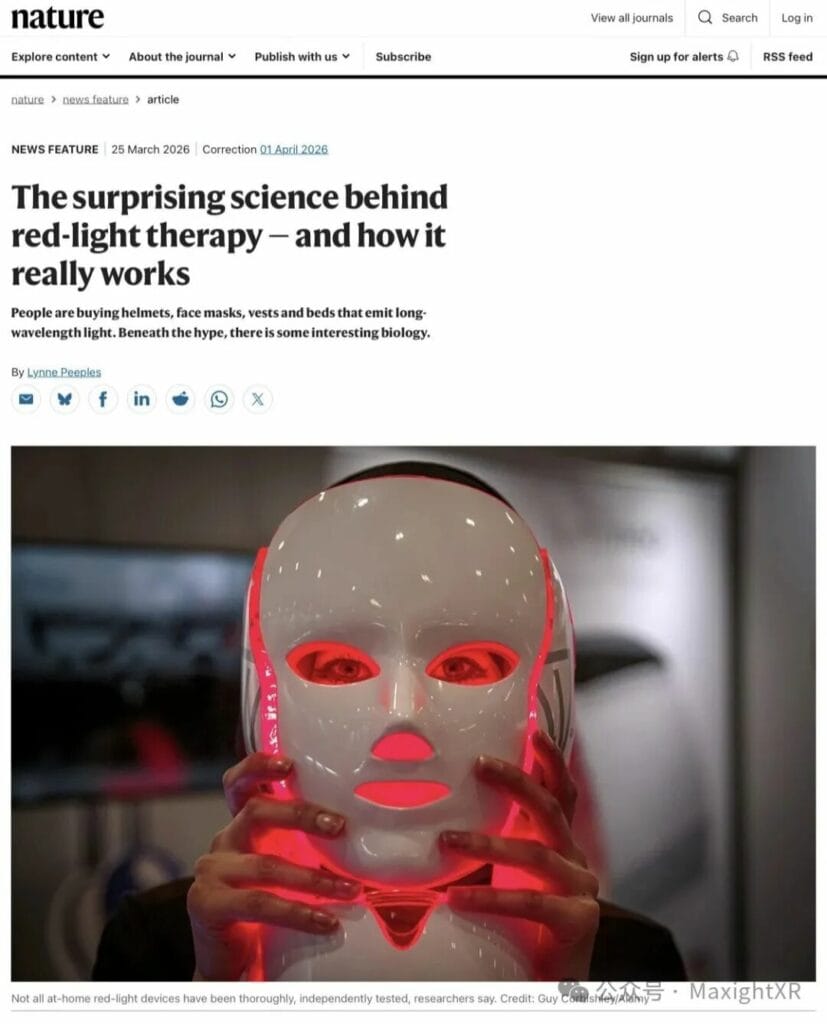
Key Highlights and Summary of the 《Nature》 (2026) Feature Article
《The Surprising Science Behind Red-Light Therapy — and How It Really Works》
Author: Lynne Peeples
Journal: 《Nature》
Publication Date: March 25, 2026
DOI: 10.1038/d41586-026-00878-1
Abstract
In recent years, a wide range of red and near-infrared light therapy devices—including helmets, masks, therapy beds, and various home-use units—has appeared on the market. While commercial marketing often involves exaggeration, a growing body of scientific research indicates that there are indeed genuine and significant biological mechanisms underlying photobiomodulation (PBM).
Once considered a fringe therapy, red light therapy is gradually entering the realm of mainstream medicine. Research demonstrates that red and near-infrared light can affect not only skin tissue but may also exert positive effects on the nervous system, retina, metabolic system, and inflammatory responses.
From the fringes of medicine to clinical application
The development of red light therapy dates back to the 1960s.
Researchers initially made an accidental discovery:
Low-intensity red light could promote hair growth in laboratory animals.
Subsequently, while researching plant cultivation in space, NASA discovered that:
Under red LED lighting, the healing rate of skin wounds appeared to accelerate significantly.
Over the past decade, an increasing number of high-quality studies have emerged.
Applications currently supported by substantial evidence include:
Chronic ulcers
Peripheral neuropathy
Radiation-induced skin injury
Androgenetic alopecia
Cancer therapy-related oral mucositis
Some of these indications have already been incorporated into clinical practice guidelines.
How does red light affect the human body?
The most widely accepted theory currently holds that:
Red light and near-infrared light act upon the mitochondria within cells.
Mitochondria are known as:
“The powerhouses of the cell.”
When light of specific wavelengths is absorbed by cytochrome c oxidase within the mitochondria, it boosts the activity of the electron transport chain, thereby increasing the efficiency of ATP (adenosine triphosphate) production.
ATP is the most important energy source for human cells.
Research indicates that subsequent physiological changes may include:
Improved blood circulation
Reduced inflammation
Regulation of oxidative stress
Enhanced tissue repair capabilities
Therefore, red light therapy is essentially a technique for modulating cellular metabolism.
Applications in the nervous system are attracting significant interest.
《Nature》 has specifically highlighted that:
Red light therapy shows immense potential in the field of neuroprotection.
In animal models of Parkinson’s disease,
researchers observed that:
animals treated with red light exhibited a marked reduction in the loss of dopamine-producing neurons.
Several human clinical trials are currently underway, investigating the use of transcranial red light irradiation to improve outcomes for:
Parkinson’s disease,
brain injury, and
neurodegenerative diseases.
Researchers have even suggested that:
red light might enable the aging brain to exhibit characteristics of a younger brain.
However, further clinical evidence is still required to substantiate this.
Ophthalmology Emerges as a Key Area of Development
The article notes:
Ocular tissues are rich in mitochondria, making them a significant target for photobiomodulation research.
Studies have found that:
Red and near-infrared light may help improve:
Retinal energy metabolism
Retinal aging
Decline in macular function
Some research indicates that:
Even without direct irradiation of the eyes,
exposure of other parts of the body to red light
may trigger systemic metabolic regulatory effects.
A key finding: more exposure is not necessarily better.
Researchers have repeatedly emphasized:
Red light therapy has a distinct “optimal dosage range.”
If the dosage is too low:
The results are limited.
If the dosage is too high:
Effectiveness actually declines.
Therefore:
Wavelength, power, distance, and duration of exposure are all crucial.
One of the major challenges for the future is establishing standardized treatment protocols.
A noteworthy new perspective
《Nature》suggests:
Modern humans may be exposed to less red and near-infrared light than at any other time in history.
Reasons include:
Spending long periods indoors
Reduced exposure to natural light
The narrowed spectral range of LED lighting
Some scientists believe:
These changes in the light environment may have biological effects that are not yet fully understood.
In other words:
The spectral environment modern humans experience differs significantly from the natural light environment to which humans adapted over the course of long-term evolution.
Nature’s Overall Conclusion
Nature adopts a stance on red light therapy that is cautious yet positive:
Red light therapy is not a miracle cure;
But it is certainly not pseudoscience.
An increasing body of research indicates that:
Red and near-infrared light, at appropriate wavelengths and dosages, can influence cellular energy metabolism, inflammatory responses, and tissue repair processes.
In the coming years,
as research into underlying mechanisms and clinical trials deepens,
photobiomodulation holds the potential to become a key component of vision health, neuroprotection, metabolic medicine, and regenerative medicine.
For the health industry as a whole,
the light environment is shifting from a neglected factor to a significant variable influencing human health.


Leave a comment